 listicle
Business Mastery Workbook for Entrepreneurs: 2026 Guide
Table of Contents
- What Is a Business Mastery Workbook and Why Entrepreneurs Need One
- Top Business Mastery Workbooks for Entrepreneurs
- Quick Comparison: Workbook Features at a Glance
- Strategic Business Blueprint for Success: Building Your Foundation
- Best Online Courses for Business Owners That Include Workbooks
- Business Growth Planning Templates: What to Look For
- How to Apply Your Workbook to Your Actual Business
- Which Workbook Should You Choose?
Last Updated: August 19, 2026
What Is a Business Mastery Workbook and Why Entrepreneurs Need One
A business mastery workbook is a structured, practical guide combining educational content with actionable exercises, templates, and reflection prompts that help entrepreneurs apply concepts directly to their own company. Unlike generic business books, they force implementation across all business areas, from strategic planning and financial management to leadership and customer acquisition.
The California Business Development Center has spent over 35 years helping entrepreneurs move from theory to execution. Most business owners struggle not from lack of ambition, but from lacking a systematic framework for decision-making. A business mastery workbook fills that gap by providing a repeatable methodology for tackling everything from operational efficiency to revenue growth.
Running a business without a structured framework is like navigating without a map. You'll eventually reach your destination but waste time, money, and energy on detours. A business mastery workbook accelerates your learning curve by distilling decades of business wisdom into actionable modules you can implement immediately.
The best workbooks include decision matrices, planning templates, assessment tools showing where your business stands today, and step-by-step exercises moving you toward measurable goals. They address the full business lifecycle, from initial planning through scaling and sustainable growth.
The Small Business Administration's guide to business planning confirms that entrepreneurs with structured planning frameworks see measurably better outcomes than those flying by instinct alone.
Top Business Mastery Workbooks for Entrepreneurs
California Business Development Center Workbooks
The California Business Development Center combines workbook content with actual business consulting and legal support. Their collection includes over 30 business mastery workbooks, each containing multiple modules covering leadership development, strategic thinking, pricing strategy, client acquisition, and management systems.
These workbooks aren't generic templates. Built on 35 years of real-world experience with hundreds of businesses, each includes 13-14 chapters with learning exercises designed to help you assess your current business acumen and apply information directly to your situation. The workbooks are updated every six months to reflect current market realities.
You're not just buying a PDF. The California Business Development Center offers complimentary initial consultations where business consultants with more than twenty years of experience help you understand which workbooks align with your specific challenges. If you're in California and need legal support, they handle everything from LLC formation to commercial lease negotiations.
Entrepreneurship Mastery: Building and Scaling Your Business (Udemy)
This online course from bestselling author Patrick Snow and business strategist Alin Marin provides an eight-module curriculum covering mindset, strategy, branding, sales, operations, authority, leadership, and legacy. The downloadable workbook includes practical exercises, reflection prompts, and templates like SWOT analysis, business blueprint, digital marketing playbook, and risk register.
The strength is accessibility and affordability, typically $19.99 to $99.99 for lifetime access. You get the workbook, video lessons, and templates in one package. The weakness is that you're entirely self-directed with no mentor available to help apply frameworks to your unique situation.
Best for solo entrepreneurs or early-stage founders comfortable learning independently with the discipline to work through modules without external accountability.
Disciplined Entrepreneurship Workbook
This workbook implements Bill Aulet's 24-step framework for building a successful business. Each step includes exercises, assessments, and real-world examples that sharpen both instincts and strategic thinking.
The standout feature is the Disciplined Entrepreneurship Canvas, a visual tracking tool monitoring your progress through all 24 steps. This framework works particularly well if you're building an innovative product and need a systematic way to validate your business model before scaling.
Expect to invest time working through each step thoroughly. This isn't a quick reference guide; it's a comprehensive business development journey.
Bite Size Business Builder by Jessica Mathison
Jessica Mathison's workbook takes a month-by-month approach to business development. Each month focuses on specific business functions, goal setting, strengths and weaknesses analysis, networking strategies, and financial management. This structure prevents overwhelm by breaking complex development into manageable chunks.
The networking strategies section is more detailed than most generic workbooks, which matters because customer acquisition is where most small businesses struggle.
Best for small business owners who feel overwhelmed and need a step-by-step, bite-sized approach rather than a comprehensive 300-page guide.
Tony Robbins Business Mastery Workbook
Tony Robbins' Business Mastery program emphasizes that business success requires both strategic thinking and psychological mastery. The workbook breaks complex concepts into manageable sections while emphasizing mindset reprogramming and habit rewiring alongside tactical skills.
The program represents a significant financial investment. The intensity appeals to entrepreneurs committed to deep transformation, not just surface-level skill-building.
Best for entrepreneurs willing to invest significantly in their own development and who respond well to Robbins' high-energy, psychology-focused methodology.
Quick Comparison: Workbook Features at a Glance
| Workbook | Format | Best For | Key Strength | Time Commitment |
|---|---|---|---|---|
| California Business Development Center | Digital + Consulting | Businesses needing legal + strategy support | Expert guidance + 35 years experience | Ongoing (flexible) |
| Entrepreneurship Mastery (Udemy) | Online course + downloadable workbook | Self-directed learners | Affordable, comprehensive curriculum | 8-12 weeks |
| Disciplined Entrepreneurship | Workbook + book | Product-focused entrepreneurs | 24-step framework with canvas tracking | 12-16 weeks |
| Bite Size Business Builder | Monthly workbook | Overwhelmed business owners | Month-by-month structure, practical focus | 12 months |
| Tony Robbins Business Mastery | Program + workbook | Transformation-focused entrepreneurs | Mindset + strategy integration | 8+ weeks intensive |
Strategic Business Blueprint for Success: Building Your Foundation
A strategic business blueprint is your operational foundation. It answers critical questions: What business are you in? Who are you serving? What problems do you solve? How do you make money? Without clear answers, every business decision becomes a guess.
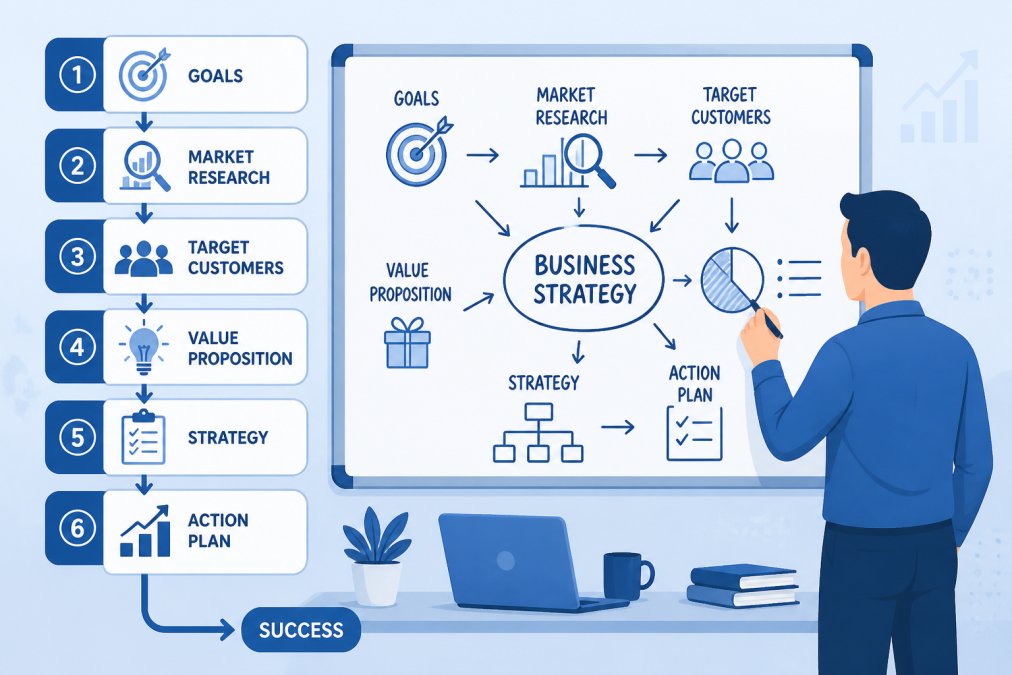
The best workbooks force you to document your business blueprint in writing. Vague thinking leads to vague execution. When you write down your business model, target customer, unique value proposition, and revenue model, you immediately see gaps and contradictions.
Your strategic blueprint should address these core elements:
- Business Model: How does your company create value and generate revenue?
- Target Market: Who exactly are you serving? Define by industry, company size, geography, and specific pain points.
- Value Proposition: What specific problem do you solve better than competitors?
- Revenue Streams: How do you make money? What's your pricing strategy and customer acquisition cost versus lifetime value?
- Operational Foundation: What systems, processes, and team structure do you need to deliver consistently?
The California Business Development Center's strategic blueprint modules walk you through each element with real-world examples and decision frameworks.
Best Online Courses for Business Owners That Include Workbooks
Online courses have become the primary way entrepreneurs access business mastery content, with the better ones including workbooks as core components rather than afterthoughts.
The Entrepreneurship Mastery course on Udemy stands out because it integrates video instruction with downloadable templates and a structured workbook. You're actively building your business blueprint as you progress through the course.
The advantage is flexibility, progress at your own pace and access content from anywhere. The disadvantage is that you're entirely responsible for accountability. Many entrepreneurs start these courses and never finish.
Look for courses that include downloadable templates and frameworks, real-world case studies, workbook exercises forcing reflection, clear progression from foundational to advanced strategy, and updated content reflecting current market conditions.
The California Business Development Center offers live video classes alongside workbooks, providing flexibility of self-paced learning with the accountability of scheduled instruction and access to experienced consultants.
Business Growth Planning Templates: What to Look For
The best business mastery workbooks include templates and frameworks you can use immediately.
SCHEDULE A FREE INITIAL CONSULTATION →
When evaluating workbook templates, look for these essentials:
Strategic Planning Templates: Business blueprint canvas, annual strategic plan, quarterly goal-setting framework, competitive positioning matrix.
Financial Planning Templates: Revenue projection model, pricing strategy worksheet, cash flow forecast template, break-even analysis calculator.
Operational Templates: Process documentation framework, organizational chart template, delegation matrix, KPI tracking sheet.
Sales and Marketing Templates: Customer acquisition cost calculator, sales pipeline template, marketing channel ROI tracker, customer retention strategy worksheet.
Leadership and Team Templates: Hiring decision matrix, delegation framework, performance review template, team communication protocol.
The California Business Development Center workbooks include all these categories because templates without context are useless. Each template includes instructions, examples from real businesses, and guidance on interpreting results.
The best templates are those you'll actually use. Avoid workbooks with dozens of unused templates. Instead, look for 10-15 critical templates explained thoroughly.
How to Apply Your Workbook to Your Actual Business
Owning a business mastery workbook is one thing. Actually applying it to your business is another.

The difference between entrepreneurs who see results and those who don't comes down to implementation discipline.
Start with your biggest challenge, not chapter one. Identify the area causing the most friction right now, whether customer acquisition, pricing, team management, or operational efficiency, and jump to those modules first.
Schedule dedicated time for workbook exercises. Block 2-3 hours per week specifically for this work. Treat it like a business meeting you wouldn't skip.
Apply one framework at a time. Choose one template, apply it to your business, gather results for 30 days, then move to the next one.
Customize templates to your business model. Generic templates are starting points. Modify them to reflect how your business actually operates.
Track your metrics before and after implementation. Measure your current customer acquisition cost, time spent on administrative tasks, and employee turnover rate. Measure again 90 days after implementing the workbook's recommendations.
Connect with accountability partners. Whether a business coach, mastermind group, or trusted peer, having someone review your progress dramatically increases follow-through.
Which Workbook Should You Choose?
The right workbook depends on your specific situation, learning style, and current business challenges.
Choose California Business Development Center Workbooks if: You need expert guidance on which modules matter most, access to legal support for business formation or contracts, and the ability to work with experienced consultants. You're willing to invest in a comprehensive solution combining workbooks with actual consulting support.
Choose Entrepreneurship Mastery (Udemy) if: You're budget-conscious, self-disciplined, and comfortable with self-paced learning. You want a comprehensive curriculum covering all major business functions with video instruction and downloadable templates.
Choose Disciplined Entrepreneurship if: You're building an innovative product and need a systematic framework for validating your business model before scaling. You're willing to invest time working through 24 sequential steps.
Choose Bite Size Business Builder if: You're overwhelmed by complexity and need permission to focus on one area at a time. You prefer a month-by-month structure preventing decision fatigue.
Choose Tony Robbins Business Mastery if: You're committed to deep personal and business transformation. You respond well to high-energy, psychology-focused methodology and are willing to make a significant financial investment.
The choice comes down to: What's your biggest constraint right now? Is it lack of knowledge, structure, expert guidance, or a proven framework?
Most entrepreneurs benefit from combining resources. Start with a comprehensive workbook to build your foundation, then add specialized resources as new challenges emerge.
Running a successful business requires mastery across multiple domains: strategy, operations, financial management, leadership, and customer acquisition. A business mastery workbook accelerates your learning by providing a structured framework instead of forcing you to learn through expensive mistakes.
The California Business Development Center's approach stands out because it combines over 30 detailed workbooks with actual consulting support and legal expertise. You're not just buying a workbook; you're getting access to 35 years of business development experience and a team of consultants ready to help you apply frameworks to your specific situation. The Harvard Business Review's research on business planning confirms that entrepreneurs with structured guidance see measurably better outcomes than those working alone. Schedule a free initial consultation with the California Business Development Center to discuss which workbooks align with your biggest business challenges and how their consulting team can support your growth strategy.
Frequently Asked Questions
How do business mastery workbooks help with strategic planning?
A business mastery workbook structures your strategic planning by breaking complex business decisions into actionable steps. It guides you through defining your vision statement, identifying KPIs, mapping your business model, and setting measurable goals. Most workbooks include templates for SWOT analysis, financial projections, and resource allocation. By working through these exercises systematically, you create accountability and ensure your strategy is documented, not just in your head. This makes it easier to track progress, adjust course, and communicate your direction to your team.
What should be included in a comprehensive business mastery workbook?
A comprehensive business mastery workbook covers entrepreneurship fundamentals, business planning, operational excellence, leadership development, and financial management. Look for sections on goal setting, decision matrices, workflow optimization, customer acquisition strategies, and performance metrics. The best workbooks include real-world templates, checklists, and learning exercises you can apply immediately to your business. They should also address scaling strategies, team management, and accountability systems. Ideally, the workbook is updated regularly to reflect current market conditions and business trends.
Are digital or physical workbooks better for entrepreneurial development?
Both formats work, depending on your learning style and workflow. Digital workbooks offer searchability, easy sharing with your team, and the ability to update information. Physical workbooks encourage deeper reflection, reduce screen fatigue, and are easier to reference during meetings or planning sessions. Many entrepreneurs find a hybrid approach works best: using a digital version for initial learning and a printed version for active planning and note-taking. The key is choosing a format you'll actually use consistently, not what feels trendy.
How can entrepreneurs track progress using a business mastery workbook?
Most business mastery workbooks include progress-tracking tools like quarterly review sections, goal-tracking sheets, and KPI dashboards. Set specific, measurable milestones in your workbook, then schedule regular check-ins (monthly or quarterly) to assess what you've accomplished. Document your wins, identify obstacles, and adjust your strategy based on results. Some workbooks provide accountability frameworks or suggest using a mastermind group for external accountability. The workbook becomes most powerful when it's a living document you return to regularly, not something you complete once and shelve.
This article was written using GrandRanker