 ultimate-guide
How to Scale Small Business in California: A 7-Step Guide
Table of Contents
- Step 1: Assess Your Current Position and Set Scaling Goals
- Step 2: Secure Access to Capital and Funding for Growth
- Step 3: Build Your Team and Ensure Hiring Compliance
- Step 4: Develop a Business Scaling Strategy and Growth Plan
- Step 5: Invest in Technology Infrastructure and Digital Systems
- Step 6: Leverage California Small Business Development Centers and Advisory Support
- Step 7: Plan for Real Estate and Physical Expansion
- Common Scaling Mistakes to Avoid
Last Updated: August 4, 2026
Step 1: Assess Your Current Position and Set Scaling Goals
Before scaling, conduct honest self-assessment of your operational, financial, and strategic position. Businesses attempting to scale without this foundation typically face cash flow problems, quality issues, and burned-out teams.
Define what scaling means for your business
Scaling doesn't mean the same thing for every business. For some, it means doubling revenue while keeping the team stable through efficiency. For others, it means expanding into new markets or adding product lines. Define what success looks like for YOUR situation.
Ask yourself: Are you scaling revenue, team size, geographic reach, or product offerings? Document your current annual revenue, team size, customer base, and operational capacity. This baseline becomes your measurement tool.
Evaluate your operational efficiency and revenue growth potential
If your operations are inefficient now, scaling will amplify those inefficiencies. Evaluate three areas: your sales process (how predictable is customer acquisition?), your delivery process (can you maintain quality while increasing volume?), and your financial management (do you have accurate profitability data by customer or product?). According to the U.S. Small Business Administration, businesses that conduct operational audits before scaling report 34% better retention rates during growth phases.
If your current systems can't handle a 50% increase in volume without breaking, fix the foundation first through technology investment, hiring operations staff, or restructuring workflows.
Step 2: Secure Access to Capital and Funding for Growth
Scaling requires capital for inventory, hiring, technology, or marketing. California offers abundant funding options, but knowing which sources fit your business stage separates successful scaling from underfunded attempts.
Explore California small business grants for expansion
California offers grant programs specifically for small business expansion. These aren't loans, you don't repay them. The tradeoff is that they're competitive and often require meeting specific criteria (minority-owned businesses, rural locations, green energy focus, etc.).
The California Governor's Office of Business and Economic Development administers multiple grant programs for workforce development, technology adoption, and export market expansion. Start by identifying which programs match your business profile.
Understand loan options and alternative funding sources
Traditional bank loans require strong credit, collateral, and a proven track record. SBA-backed loans (7(a) loans and microloans) offer lower rates than conventional commercial loans because the federal government shares the risk. Equipment financing and leasing are other options if you're investing in machinery or technology.
Beyond loans, consider revenue-based financing (you repay a percentage of monthly revenue until a cap is reached) or equity financing from investors. Each option has trade-offs. Equity financing dilutes your ownership but brings expertise and networks. Debt financing preserves ownership but requires cash flow to service payments.
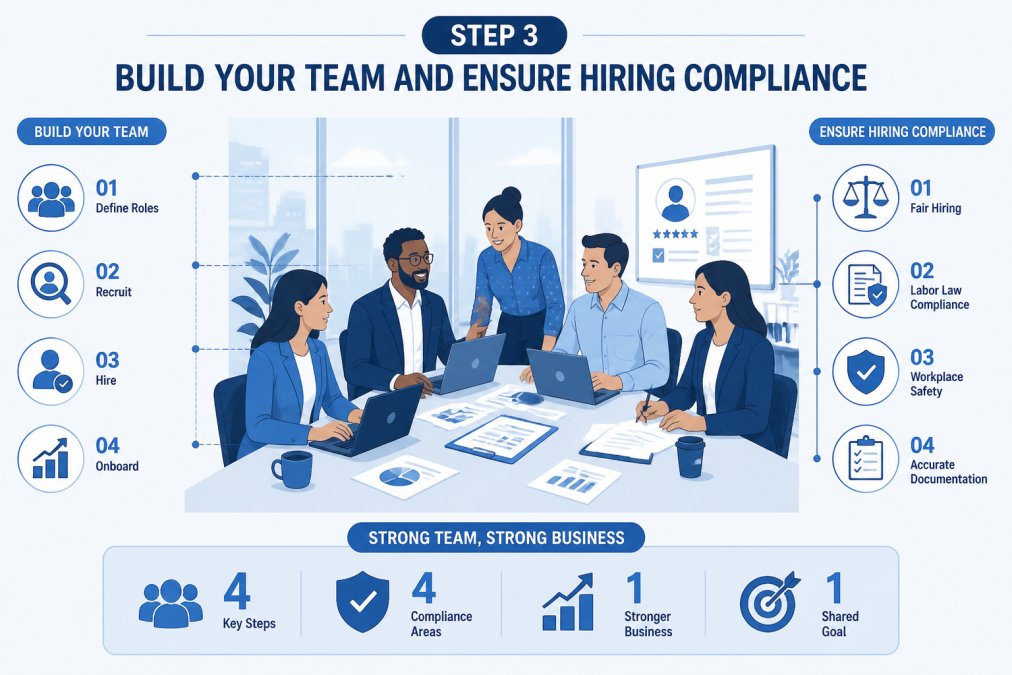
Step 3: Build Your Team and Ensure Hiring Compliance
Scaling without the right team is like driving with a broken transmission. California's employment laws are among the strictest in the nation, making hiring compliance a legal requirement that directly affects your scaling timeline and costs.
Navigate California employment law and labor regulations
California employment law is notoriously complex. Minimum wage, overtime rules, break requirements, worker classification (employee vs. independent contractor), and benefits mandates all have specific rules. The biggest mistake is misclassifying workers as independent contractors when they should be employees. California's ABC test makes this determination strict: if you control how, when, or where work is done, the person is likely an employee. Misclassification can cost thousands in back wages, penalties, and legal fees.
Before hiring anyone, understand California-specific requirements: minimum wage (which varies by city and county), meal and rest break rules (non-negotiable), overtime calculations (1.5x for hours over 8 per day or 40 per week, 2x for hours over 12), and paid family leave eligibility. You'll also need workers' compensation insurance, which is mandatory.
The California Department of Industrial Relations publishes updated labor law posters and guides. Your accountant or an employment attorney should review your hiring practices before scaling. Document everything as you scale: job descriptions, performance expectations, pay scales, and policies. Informality works with five people but creates legal liability at fifteen.
Step 4: Develop a Business Scaling Strategy and Growth Plan
Scaling without a strategy is chaos with ambition. A scaling strategy answers: Where are you growing? Who are you serving? How will you compete? What metrics define success?
Create your strategic business blueprint
Your scaling strategy should address market expansion, customer acquisition, product or service expansion, and operational capacity. A strategic business blueprint isn't a 50-page document, it's a clear, written answer to five questions: (1) What specific market or customer segment are you targeting? (2) What's your competitive advantage in that segment? (3) What's your revenue model? (4) What operational investments do you need? (5) What's your timeline and key milestones?
This blueprint becomes your decision filter. When opportunities arise, you evaluate them against your strategy. If they don't fit, you say no.
Address scaling barriers and market expansion opportunities
Every business faces barriers to scaling. Yours might be limited geographic reach, high customer acquisition costs, production capacity constraints, or talent availability. Identifying these barriers explicitly lets you build solutions into your plan.
For market expansion, research your target markets thoroughly. The U.S. Census Bureau provides demographic and economic data by region to help you understand where your target customers are. Common scaling barriers include: cash flow timing, quality consistency, key person dependency, and operational bottlenecks. Name your barrier explicitly, then build a solution.
Step 5: Invest in Technology Infrastructure and Digital Systems
Scaling with spreadsheets and manual processes will destroy your business. As you grow, you need systems that handle volume without requiring proportional increases in administrative overhead.
Select systems that support operational efficiency at scale
Most scaling businesses need: a customer relationship management (CRM) system to track leads and customers, accounting software to manage finances accurately, project management tools to coordinate teams, and communication platforms to keep teams aligned.
The mistake most businesses make is over-investing in complex systems before they're ready. You don't need an enterprise resource planning (ERP) system with five employees. Start with a CRM that tracks customer interactions and basic accounting software. As you grow to twenty people, add project management and inventory tracking.
Start with systems that integrate well together. If your CRM doesn't talk to your accounting software, you're creating manual work and data inconsistency. Budget for implementation time and training. New systems don't save time on day one. Plan for 2-4 weeks of reduced productivity as your team learns new systems.
Step 6: Use California Small Business Development Centers and Advisory Support
You don't have to figure out scaling alone. California Small Business Development Centers (SBDCs) offer free or low-cost consulting, training, and resources specifically designed for businesses like yours.

Access technical assistance and mentorship programs
The California SBDC network connects you with experienced business advisors who've seen hundreds of businesses scale. They can help you avoid common mistakes, identify blind spots in your plan, and access resources you might not know existed. This support is typically free or very low-cost.
An advisor can review your financial projections and tell you if they're realistic. They can help you understand California employment law as it applies to your situation. They can introduce you to lenders, investors, or partners in your industry. SBDCs also offer workshops on financial management, marketing strategy, export regulations, and accessing capital.
Work with business advisors on regulatory compliance and business development
As you scale, regulatory compliance becomes more complex. California has specific rules around data privacy (California Consumer Privacy Act), environmental compliance, industry-specific licensing, and employment practices. Missing compliance deadlines or misunderstanding regulations can derail scaling efforts or create legal liability.
Business advisors can help you understand which regulations apply to your business and what compliance steps you need to take. They can also connect you with specialists (attorneys, accountants, industry consultants) when you need deeper expertise. The California Business Development Center provides comprehensive support combining business development consulting with legal guidance, critical because scaling decisions have legal implications.
Step 7: Plan for Real Estate and Physical Expansion
If your business requires physical space, scaling means managing real estate decisions. This applies to retailers, manufacturers, service businesses with offices, and any operation where location and facility size affect your ability to serve customers.
Evaluate facility needs and commercial lease considerations
Before signing a lease, understand exactly how much space you need and how long you'll need it. Commercial leases in California are typically three to five years. Signing a lease that's too large wastes money. Signing one that's too small means you'll outgrow it and face expensive relocation.
Calculate space requirements by function: production/delivery space, office space, storage, and customer-facing areas. Then add 20-30% buffer for growth and operational flexibility. Understand lease terms carefully, total occupancy cost includes base rent, common area maintenance fees, property taxes, and insurance. Negotiate renewal options and expansion rights. Location matters significantly; a cheaper location farther from your customers or suppliers might cost more in transportation and time than a more expensive location closer to your operations.
Common Scaling Mistakes to Avoid
Understanding what NOT to do is as important as knowing what to do.
Scaling too fast without operational foundation. Growing revenue 100% in a year is exciting until your team is exhausted, quality suffers, and customers complain. Sustainable scaling typically means 30-50% annual growth while maintaining quality and team stability.
Hiring the wrong people or too many people too quickly. Adding team members before you've documented processes means each person does things differently. Payroll is your largest scaling cost and it's hard to reduce if growth slows.
Underestimating capital requirements. Most businesses underestimate how much capital scaling actually requires. Add 30% to your capital estimate as buffer.
Losing focus on profitability. Growing revenue while losing profitability is a trap. Every scaling decision should improve or maintain unit economics.
Ignoring customer retention while chasing new customers. It's cheaper to keep customers than acquire new ones. If your scaling strategy assumes you can lose 30% of customers annually and replace them with new ones, your economics are broken.
Failing to document and delegate. Founders often try to personally manage every aspect of scaling. This creates bottlenecks and prevents real growth.
Not adjusting compensation and incentives. As your business scales, compensation structures that worked for a small team don't work anymore. You need performance metrics tied to compensation and career paths that align team interests with business success.
| Mistake | Impact | Prevention |
|---|---|---|
| Scaling without operational foundation | Quality suffers, team burns out, customers leave | Audit operations first, fix inefficiencies before growing |
| Hiring too quickly | Inconsistent work, management chaos, high turnover | Document processes before hiring, hire deliberately |
| Underestimating capital needs | Running out of cash mid-scale | Add 30% buffer to capital estimates, secure funding early |
| Losing focus on profitability | Revenue growth masks declining margins | Track unit economics, ensure scaling improves profitability |
| Neglecting retention | High churn offsets new customer acquisition | Build retention metrics into scaling plan |
| Founder bottleneck | Business can't grow beyond founder capacity | Document processes, delegate authority, build management team |
| Wrong compensation structure | Retention problems, misaligned incentives | Review and adjust compensation as team grows |
Moving Forward With Your Scaling Plan
Scaling a small business in California requires balancing ambition with discipline. The seven-step approach above gives you a framework, but execution is where most businesses struggle. You need support from people who understand California's specific business environment, its regulations, funding landscape, talent market, and regional differences.
The California Business Development Center combines business consulting with legal expertise to address both the strategic and legal dimensions of scaling. Their Strategic Business Blueprint modules provide comprehensive resources covering everything from financial management to hiring compliance to market expansion.
If you're serious about scaling, start with a free initial consultation. Discuss your specific situation, get clarity on what you need to address first, and understand what support is available.
SCHEDULE A FREE INITIAL CONSULTATION
Frequently Asked Questions
What government resources are available for scaling businesses in California?
California Small Business Development Centers (SBDC) offer free or low-cost technical assistance, business planning support, and advisory services. The California Office of the Small Business Advocate (CalOSBA) provides advocacy and connects businesses to resources. Additionally, the U.S. Small Business Administration (SBA) supports California businesses through local resource partners, mentorship programs via SCORE, and information on small business loans. Many counties offer specific programs targeting business development and market expansion.
How do I access small business capital in California?
Multiple pathways exist for funding. Traditional small business loans California offers include SBA loans, bank financing, and lines of credit. California small business grants for expansion are available through state agencies and non-profit organizations, though grants are typically competitive. Alternative funding includes venture capital, angel investors, crowdfunding, and equipment financing. Start by consulting with a business advisor or SBDC to identify which funding options match your business stage, industry, and growth timeline.
What are the biggest challenges when scaling a business in California?
Common scaling barriers include access to capital, hiring talent and managing California employment compliance, managing operational efficiency during growth, securing affordable real estate for expansion, and navigating regulatory compliance. Tax implications of scaling, technology infrastructure costs, and workforce development also present challenges. Working with experienced business advisors and legal consultants helps you anticipate these obstacles and build a strategic blueprint that addresses them before they derail growth.
How do I ensure compliance when hiring employees in California?
California has strict employment laws covering minimum wage, overtime, breaks, and worker classification. Register with the California Department of Industrial Relations, understand AB 5 independent contractor rules, secure workers' compensation insurance, and maintain proper payroll records. Develop an employee handbook addressing state-specific requirements. Consulting with a business attorney experienced in California labor law ensures you avoid costly compliance mistakes during rapid hiring phases of scaling.
This article was written using GrandRanker