 how-to
Strategic Roadmap for Business Success: A Step-by-Step Guide
Table of Contents
- What Is a Strategic Roadmap and Why It Matters
- Strategic Roadmap vs. Strategic Plan: Key Differences
- Core Components Every Strategic Roadmap Needs
- How to Build a Strategic Roadmap: 6 Steps to Execution
- Step 1: Define Your Strategic Vision and Objectives
- Step 2: Conduct a Market and Internal Analysis
- Step 3: Set Strategic Priorities and Initiatives
- Step 4: Establish Milestones and Key Performance Indicators
- Step 5: Allocate Resources and Assign Ownership
- Step 6: Create Visual Roadmap Depiction and Communication Plan
- Strategic Roadmap Template: Framework for Your Business
- Business Roadmap Examples Across Industries
- Strategic Planning Best Practices for Roadmap Success
- Strategic Roadmap Software Tools and Integration
Last Updated: August 6, 2026
What Is a Strategic Roadmap and Why It Matters
A strategic roadmap is a visual and narrative plan that outlines your business's direction, priorities, and key milestones over a defined time horizon. It bridges the gap between your long-term vision and day-to-day execution.
Unlike a vague mission statement, a strategic roadmap is actionable. It specifies what you'll accomplish, when, and how you'll measure progress. The California Business Development Center has worked with hundreds of businesses over 35 years, and one pattern emerges consistently: companies with a documented strategic roadmap outpace those without one. They make faster decisions, allocate resources more effectively, and adapt to market shifts without losing sight of core objectives.
A strategic roadmap matters because it forces clarity. When leadership builds one, assumptions surface, disagreements about priorities become visible, and resource constraints become real. It's far better to discover misalignment in planning than in execution.
Strategic Roadmap vs. Strategic Plan: Key Differences
A strategic plan is a comprehensive written document that answers: Where are we? Where do we want to go? How will we get there? It's typically reviewed annually.
A strategic roadmap takes that thinking and visualizes it. It shows the sequence of initiatives, timeline, dependencies, and measurable outcomes. Where a strategic plan says "We will improve customer retention," a roadmap says "Q2 2026: Launch loyalty program. Q3 2026: Integrate with email platform. Q4 2026: Target 15% improvement in repeat purchase rate."
The strategic plan answers the "why" and "what." The roadmap answers the "when" and "how we'll know it worked." A strategic plan is static; a strategic roadmap is dynamic. You review the plan annually and the roadmap monthly. For California businesses navigating regulatory complexity and market competition, this distinction keeps execution aligned with strategy in real time.
Core Components Every Strategic Roadmap Needs
A solid strategic roadmap contains five essential elements.
Current State Assessment
Before mapping where you're going, understand where you are. This means knowing your competitive position, operational strengths and weaknesses, customer base, and financial health.
Document your current state with specificity: What's our market share? What are our top revenue drivers? Where do we lose customers? What are our operational bottlenecks? Numbers matter. "Our annual churn rate is 22%, concentrated in the first 90 days after purchase" is actionable; "We have good customer retention" is not.
Desired State and Long-Term Vision
Articulate what success looks like in 3-5 years. Not "grow revenue," but what does your business look like when you've executed successfully? Your desired state should be specific enough to guide decisions but not so prescriptive that you can't adapt.
The desired state also clarifies what you're not trying to become, eliminating a thousand small decisions throughout the year.
Strategic Priorities and Initiatives
These are the major programs of work that move you from current state to desired state. Strategic priorities typically number between three and five. Examples might include: "Launch new product line," "Expand into adjacent market," "Improve operational efficiency by 30%."
Each priority should have 2-4 initiatives beneath it, concrete programs with a clear owner, timeline, and success metric.
Milestones, KPIs, and Measurable Outcomes
Define what success looks like at each phase. Milestones are major checkpoints: "Product launch complete by Q3 2026." Key Performance Indicators measure progress toward your desired state. The best KPIs are leading indicators tracked monthly, not lagging ones discovered at year-end.
How to Build a Strategic Roadmap: 6 Steps to Execution
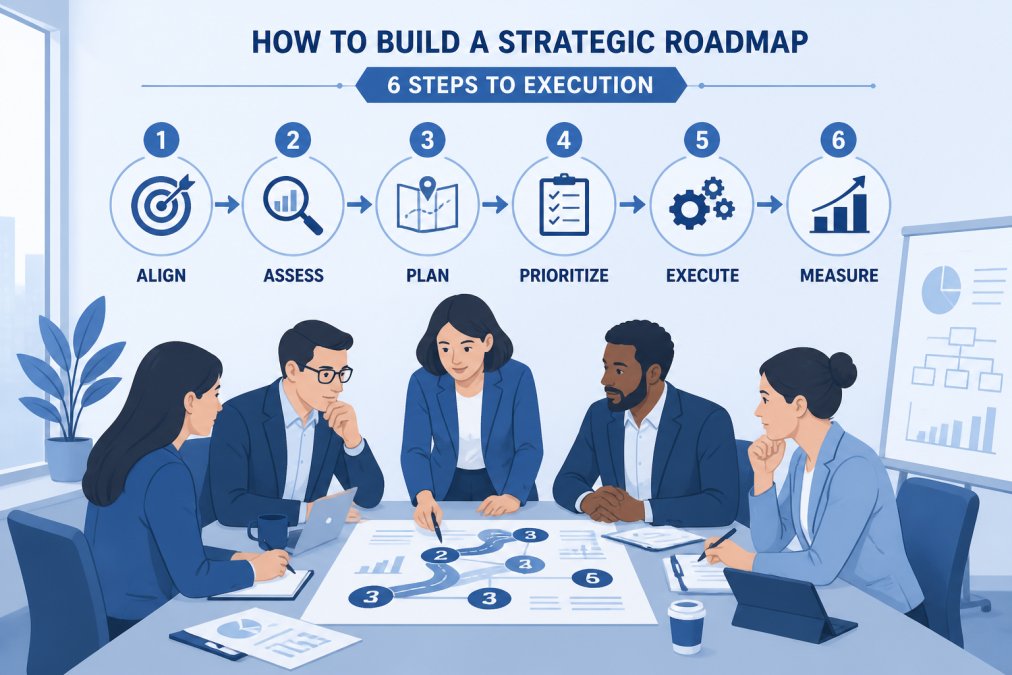
Step 1: Define Your Strategic Vision and Objectives
Bring together your leadership team and ask: What problem do we solve? Who benefits most? What would make us proud in five years? These conversations surface disagreement, valuable for alignment.
Document your vision in one or two clear sentences. "We will become the most trusted advisor for California businesses navigating growth and legal complexity" is a vision. Your strategic objectives flow from your vision.
Step 2: Conduct a Market and Internal Analysis
Understand your competitive landscape and your own capabilities. A market analysis examines competitors, their strengths and vulnerabilities, total addressable market size, and regulatory or economic shifts. An internal analysis examines your genuine competitive advantages, weaknesses, and financial capacity to invest.
Be realistic about both. Many businesses overestimate competitive advantages and underestimate operational constraints.
Step 3: Set Strategic Priorities and Initiatives
Based on your vision, objectives, and analysis, determine the 3-5 major priorities. Each priority should answer: Why does this matter? What's the expected outcome? Who owns it? When will it be complete?
Break each priority into specific initiatives with clear owners and timelines. Sequence them, some can run in parallel; others depend on earlier initiatives completing first.
Step 4: Establish Milestones and Key Performance Indicators
For each initiative, define what done looks like. Milestones should be specific and time-bound: "Launch product to beta customers by Q3 2026." KPIs should measure progress toward strategic objectives. If your objective is "establish thought leadership," a KPI might be "publish two industry research reports annually."
Step 5: Allocate Resources and Assign Ownership
Determine how much each initiative will cost, how many people it requires, the timeline, and who owns it. This is where many roadmaps fail, leadership agrees to five priorities, but the organization lacks bandwidth to execute all of them. Make trade-offs explicit: "We're focusing on customer retention this year, which means we're not pursuing the enterprise market."
SCHEDULE A FREE INITIAL CONSULTATION →
Step 6: Create Visual Roadmap Depiction and Communication Plan
A strategic roadmap that lives in a Word document won't drive action. Create a visual depiction, a timeline showing initiatives across quarters, a swimlane diagram showing dependencies, or a one-page visual showing priorities and key milestones.
Create a communication plan. How often will you review progress? Who attends? What decisions need to be made?
Strategic Roadmap Template: Framework for Your Business
| Component | Description | Example |
|---|---|---|
| Vision Statement | Where we're headed in 3-5 years | Become the trusted growth advisor for California mid-market businesses |
| Strategic Objectives | 3-4 outcomes that define success | Establish thought leadership; Build scalable service delivery; Expand into adjacent services |
| Strategic Priorities | 3-5 major programs of work | Launch advisory membership; Develop legal compliance framework; Build content library |
| Key Initiatives | Specific projects under each priority | Recruit advisory board members; Create 12-module curriculum; Publish monthly research |
| Milestones | Major checkpoints with dates | Advisory program launch Q2 2026; Content library complete Q4 2026 |
| KPIs | Metrics that measure success | 50 advisory members by Q4 2026; 100K monthly website visitors by Q3 2026 |
| Resource Allocation | Budget and team assigned | $150K annual budget; 1.5 FTE dedicated; VP of Product oversight |
Business Roadmap Examples Across Industries
A SaaS company might prioritize: launch new product tier, expand into European market, improve customer onboarding, reduce churn by 5%. A professional services firm might prioritize: develop signature service offering, build thought leadership, expand geographic reach, transition to retainer-based pricing. A manufacturing company might prioritize: automate production line, reduce defect rate, launch direct-to-consumer channel, improve supply chain resilience.
The common thread: each roadmap connects strategic objectives to specific, measurable initiatives with clear ownership and timelines.
Strategic Planning Best Practices for Roadmap Success
Start with honest assessment. Discover uncomfortable truths early, unprofitable customers, competitive threats, skill gaps, rather than during execution.
Involve your team. The CEO shouldn't build the roadmap in isolation. Bring in your leadership team and key contributors. They'll own the roadmap more fully if they shaped it.
Sequence ruthlessly. Be explicit about what must happen first. Some initiatives create the foundation for others.
Build in flexibility. Your roadmap is a plan, not a prediction. Markets shift, competitors move, opportunities emerge. Your roadmap should have room to adapt.
Review and adjust regularly. Monthly reviews keep the roadmap alive. What's on track? What's at risk? What's changed? These conversations are where the roadmap becomes a tool for decision-making.
Communicate progress. Your team needs to understand how their work connects to the roadmap. Quarterly all-hands meetings reviewing progress build alignment and motivation.
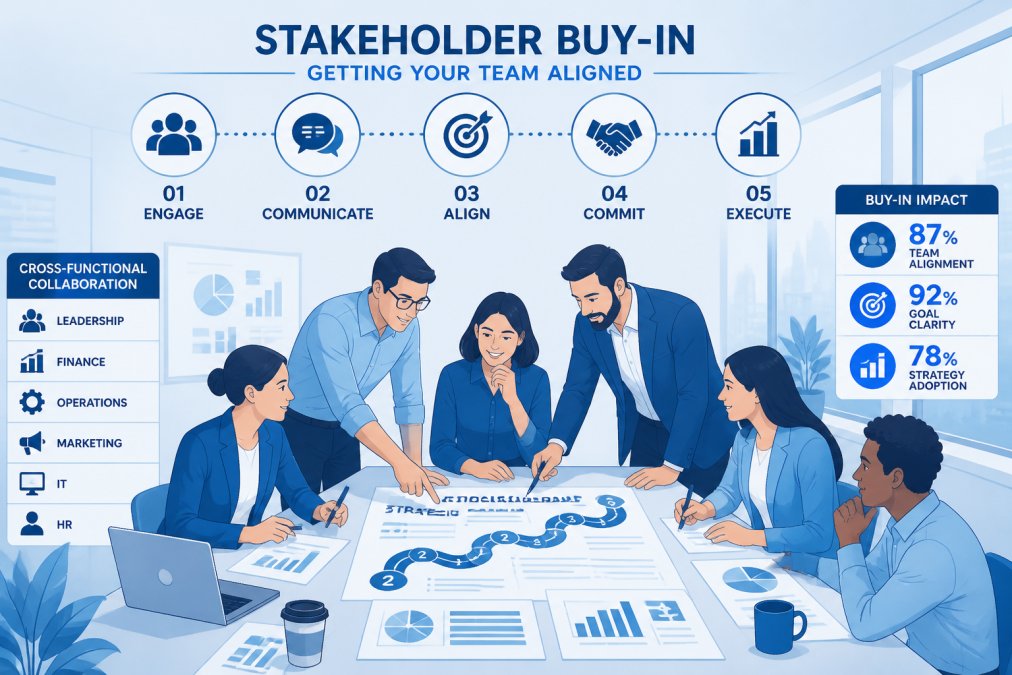
Stakeholder Buy-In: Getting Your Team Aligned
A strategic roadmap only works if your team believes in it and understands their role. Getting buy-in starts during the planning process, bring people into the conversation, not just announce the roadmap after leadership decides.
It continues through clear communication: What are we trying to achieve? Why does it matter? How does my work contribute? It's sustained through progress visibility. When people see the roadmap is real, that leadership is tracking and adjusting it, they take it seriously.
Strategic Roadmap Software Tools and Integration
Dedicated roadmap tools like Roadmunk, ProductPlan, and Aha! are built specifically for roadmap creation and visualization. Project management tools like Asana, Monday.com, and Jira can accommodate roadmap functionality. Business intelligence tools like Tableau and Looker can visualize progress against KPIs. Spreadsheet templates work for small teams with simple roadmaps.
The tool you choose matters less than consistent use. A spreadsheet reviewed monthly beats expensive software that's abandoned.
Maintaining Your Strategic Roadmap Over Time
Set a monthly review cadence with your leadership team. Spend 90 minutes reviewing progress, discussing blockers, and updating timelines. Quarterly, take a step back: Are we still on track? Has the market changed? Do we need to adjust priorities? Annually, revisit your strategic vision and objectives.
This ongoing attention separates roadmaps that drive results from those that become filing cabinet artifacts.
Building a strategic roadmap requires clarity, discipline, and follow-through. The process forces you to think deeply about your direction, make hard trade-offs, and align your organization around shared objectives. A clear roadmap actually creates space by eliminating confusion and conflicting priorities.
The California Business Development Center has guided hundreds of California businesses through this process using our "Strategic Business Blueprint For Success" framework, which includes over 120 modules and detailed workbooks designed to help you build a roadmap tailored to your specific situation. Whether you're a founder launching a new venture, a management team trying to scale, or a business owner navigating growth challenges, having a structured approach to strategic planning makes the difference between drifting and directing. According to research on business planning from the U.S. Small Business Administration, companies with documented strategic plans are significantly more likely to achieve their growth targets. Our team can help you develop the roadmap that moves your business forward. SCHEDULE A FREE INITIAL CONSULTATION to discuss your strategic priorities and how we can support your growth.
Frequently Asked Questions
What are the 5 key components of a strategic roadmap?
A strategic roadmap requires five essential components: current state assessment (where you are now), desired state vision (where you want to go), strategic priorities and initiatives (what you'll focus on), milestones and measurable outcomes (how you'll track progress), and resource allocation (who does what). These components work together to create an execution bridge between your strategic vision and operational reality, ensuring every team member understands the path forward and their role in achieving business growth.
How often should you update your strategic roadmap?
Most businesses review and update their strategic roadmap quarterly, with a comprehensive refresh annually. This cadence allows you to respond to market changes, adjust resource allocation based on performance data, and maintain strategic agility without losing focus on long-term goals. Small businesses may need more frequent adjustments due to market volatility, while established companies can often operate on longer review cycles. The key is building in regular checkpoints to assess KPIs and course-correct initiatives that aren't delivering expected outcomes.
What is the difference between a strategic plan and a strategic roadmap?
A strategic plan outlines your overall business strategy, philosophy, and long-term vision, it answers 'why' and 'what.' A strategic roadmap is the visual, actionable execution tool that shows 'how' and 'when' you'll achieve those goals. The roadmap breaks down strategic objectives into specific initiatives, milestones, and timelines with assigned ownership and KPIs. Think of the plan as your blueprint; the roadmap is the construction schedule that keeps everyone coordinated and accountable.
How do you create a strategic roadmap for a small business?
Start with a clear vision of where you want to be in 3-5 years, then assess your current market position and resources. Identify 3-5 strategic priorities that will drive the most business improvement, break them into specific initiatives with milestones, and assign measurable outcomes (KPIs). Use a simple visual format, a timeline or Gantt chart works well, to show phases, dependencies, and resource needs. The process doesn't require complex software; many small businesses succeed with a spreadsheet or basic roadmap template, as long as the roadmap is communicated clearly to your team and reviewed regularly.
This article was written using GrandRanker